Japanese Writing Systems
Japanese is written using several different kinds of characters for different purposes.
English-style (Roman) letters are called romaji.
These are sometimes used for trademarks, advertising slogans,
and commands to some old-fashioned computers.
 The kanji are Chinese-style characters that the
Japanese adopted around the fifth century A.D.
Kanji are still used to write many words in Japanese.
The kanji are Chinese-style characters that the
Japanese adopted around the fifth century A.D.
Kanji are still used to write many words in Japanese.
The kana are simpler symbols that stand for sounds. There are two kinds of kana: hiragana and katakana.
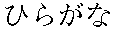 The hiragana characters are written
in a curving, flowing style. They are
used for writing some native Japanese
words and word endings.
The hiragana characters are written
in a curving, flowing style. They are
used for writing some native Japanese
words and word endings.
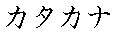 The katakana are more angular
characters. They are used mostly for
writing foreign-derived words.
Words adapted into Japanese from English or other European languages are
usually written in katakana.
The katakana are more angular
characters. They are used mostly for
writing foreign-derived words.
Words adapted into Japanese from English or other European languages are
usually written in katakana.
Many words may be written in either kanji or kana depending on the educational level of the writer and readers. Kana are used most heavily in documents for people who do not know many kanji yet, such as Japanese children. Also, kana are sometimes written above difficult or obscure kanji, to explain the meaning of the kanji.
Usually each kana symbol stands for one syllable. (There are a few kana characters that stand not for syllables, but for modifications to other syllables.)
To develop a full understanding of the relationship between kana and their sounds, you will need to study spoken Japanese so that you will understand the system of sounds. The best way to learn spoken Japanese is to study with a skilled teacher who is fluent in the language.
It could also help to use TileTag for Kana
to play sounds associated with the kana.
Hiragana and Katakana Explained
The Basic-Form Hiragana and Katakana
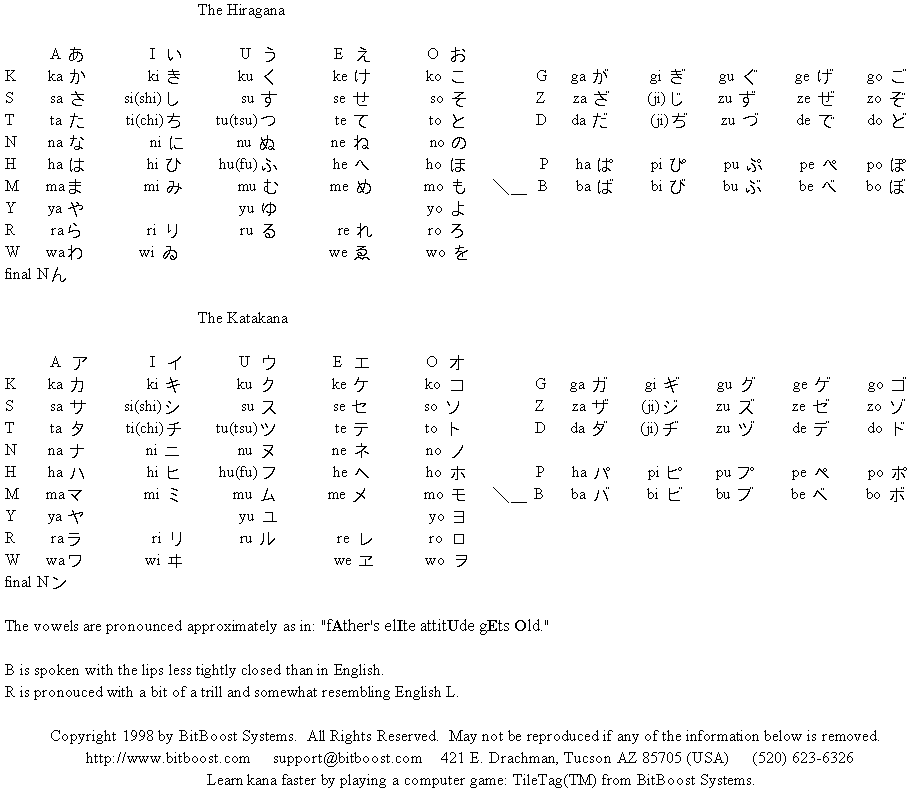
The table below shows the basic hiragana and katakana in their usual "alphabetical order." (Two of the w- kana, wi and we, are rarely used in modern times.)

|
|
You can print this table for easy reference. It shows the kana in the typescript form usually seen in books and computer output.(1) |
The Voiced and Plosive (G-, Z-, D-, P-, B-) Forms
Japanese also includes some other consonants that aren't in the tables above. Let's see how those other consonants are written.
The kana for these other consonants are created by adding marks to the basic-form kana.
When the consonants k, s and t are spoken, the speaker's vocal cords don't vibrate. If the vocal cords vibrate, these consonants change:
k becomes g
s becomes z
t becomes d
(To help you to understand about this vibration, you can try to speak these consonants with a finger resting gently on your adam's apple to feel when there is vibration.)
This vibration is indicated by drawing two dots or short lines to the upper right of a kana.
ka  ga
ga 
sa  za
za 
etc...
The consonant p is spoken much like h, but with initially closed or pursed lips. To show this we draw a little circle, like closed lips opening.
ha  pa
pa 
hi  pi
pi 
etc...
The consonant b is spoken much like p, but with vibrating vocal cords. To show this we draw two short lines to the upper right of an h+vowel kana.
ha ba 
hi bi 
etcetera...
By using these tricks to create some kana from others, the Japanese made it easier to learn the kana for syllables having g, z, p, b, etc.
The voiced and plosive consonants are on the right side of the table below. (You might have to scroll your browser window to see them.)
|
|
You can print this table for easy reference. To show the whole chart on one page you might need to print in landscape mode.(2) |
Long Vowels
In Japanese, vowels may be single-length or double-length. A double-length vowel lasts twice as long as a single-length vowel. A single-length vowel has a different meaning than a double-length vowel, just as in English different consonants or different vowels have different meanings.
Double vowels are written with two vowel kana in sequence. For example, in hiragana:
"a" is written as:  .
.
"aa" is written as: 
 .
.
The vowels e and o are sometimes doubled by adding different vowels:
"ee" can be written as either  (ee) or
  (ei).
(ei).
"oo" can be written as either  (oo) or
  (ou).
(ou).
These methods of writing long vowels apply for katakana as
well as for hiragana, even though the examples above happen
to be hiragana.
Long Consonants
You can show that a consonant is lengthened by writing a miniature "tsu" kana before the consonant. However, if you want to double "n," you should write the normal kana for "n," rather than a small "tsu."
Example:  (3)
(3)
Y Dipthongs (KYA, GYU, BYO, etc.) and
the general SH, CH, J sounds
Japanese includes syllables of a <consonant + Y + vowel> pattern. These are written by writing a normal
<consonant + I> kana, plus a <miniature Y + vowel> kana.
A hiragana example:
"ki" = 
"ya" = 
so "kya" = ki + ya = 
From the basic hiragana chart, we already know we can write
"shi" as  ,
"chi" as
,
"chi" as  ,
and "ji" as
,
and "ji" as  .
We already know
katakana for these syllables also. But spoken Japanese also
includes combinations of these consonants with other vowels:
"sha", "sho," "shu", "cha", "ja", etc. How can we write
these?
.
We already know
katakana for these syllables also. But spoken Japanese also
includes combinations of these consonants with other vowels:
"sha", "sho," "shu", "cha", "ja", etc. How can we write
these?
We can write them by combining a "shi" or "chi" kana with a small <y + vowel> kana. For example:
"shi" =
"ya" =
so "sha" = shi + ya = 
Special Spellings
A few words have strange spellings for historical reasons. For
example, the hiragana
normally means the sound "ha," but
for historical reasons it is used to write the preposition/particle
"wa." Similarly a special hiragana  is used for the
preposition/particle "o", even though the sound "o" is usually
written as
is used for the
preposition/particle "o", even though the sound "o" is usually
written as  .
.
Putting It All Together

The Japanese write using hiragana, katakana, kanji, and romaji, as we explained in "Japanese Writing Systems" above. Japanese is usually written either top-to-bottom(4) or left-to-right. Unlike in English, words are not normally separated by spaces. Punctuation is fairly similar to English, except that if a question ends in the question word "ka," a period rather than a question mark ends the sentence. The sentence below is an example of such a 'period-question.'
This web page "The Hiragana and Katakana Explained" is based on part of a manual included with our educational software product TileTag for Kana.
We also have a list of links to additional educational resources helpful for learning to read and write Japanese.
Software Teaches the Hiragana and KatakanaYou can learn all the kana by playing a computer game: TileTag for Kana .
TileTag
was designed to be enjoyable,
and has been refined through the repeated feedback of students and teachers of Japanese.
It costs only $16,
which is a great price for making kana study enjoyable and easier.
If you're not sure about it, you can
download a free 40-character version of TileTag for Kana,
with 20 katakana and 20 hiragana. .
TileTag
was designed to be enjoyable,
and has been refined through the repeated feedback of students and teachers of Japanese.
It costs only $16,
which is a great price for making kana study enjoyable and easier.
If you're not sure about it, you can
download a free 40-character version of TileTag for Kana,
with 20 katakana and 20 hiragana.
|
Notes
(1) Typescript forms are the forms of the characters used in most typeset and printed documents. Handwriting can be a little different.
(2) Landscape mode is the printing mode where the page is turned 90 degrees, so the paper's longer dimension is the width instead of the height. Ways of setting this may vary between different browsers and printers.
To print in landscape mode, you might try picking File - Print from your browser's main menu, and in the print window that apppears, try clicking on the "Properties" button. Somewhere in the window that then appears, there should be an "Orientation" option that you can switch to "Landscape." Then print. The next time that you print, you can set the option back to "Portrait."
(3) "tottemo" means "very, extremely."
(4) The example of vertically written hiragana script says "Ii desu nee!" (which means, more or less, "This is cool!")
(5)
 = Wakarimasu ka? (which means "Do you understand?")
Questions? Please contact us.
|
(Intro Page) Full Version TileTag Demo/ Freeware (includes 40 kana) for TileTag |
|
Systems main page |
 .
.